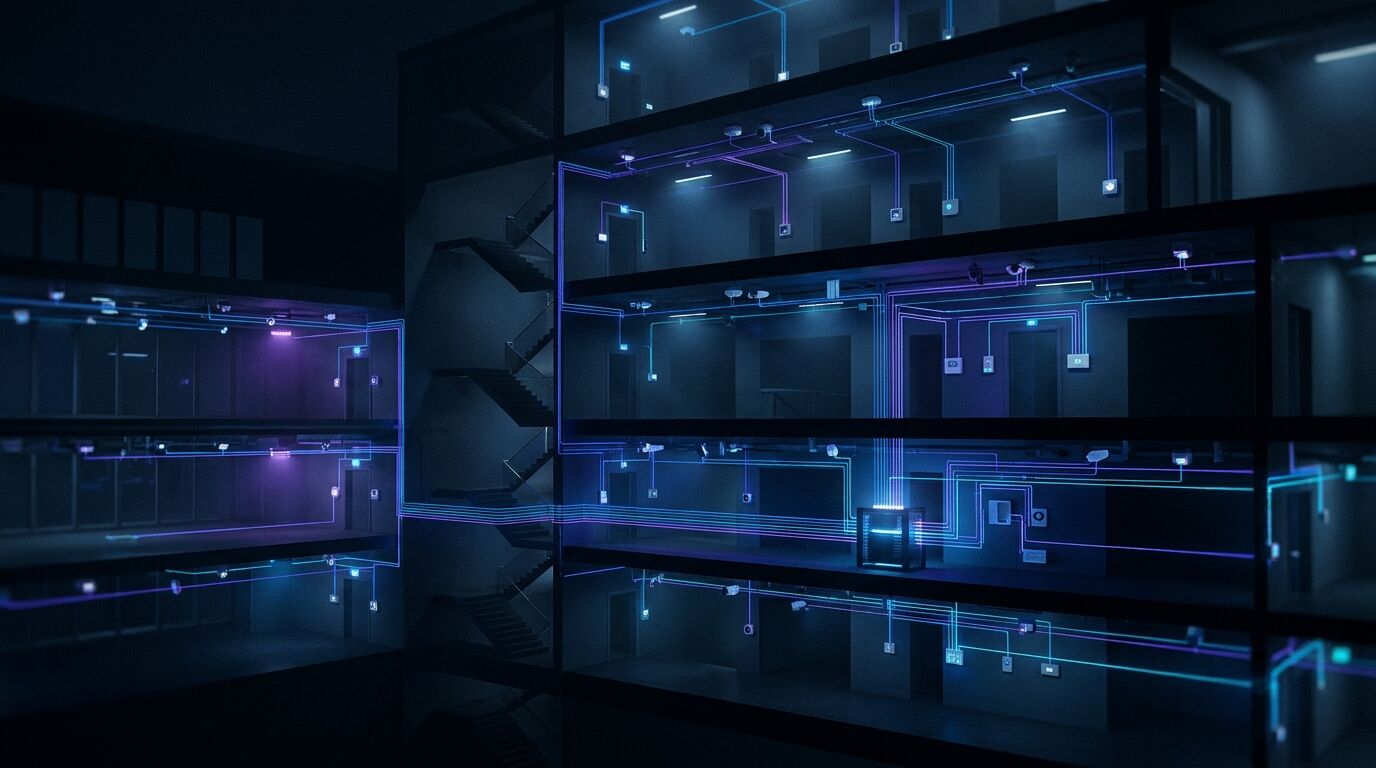
You installed the device. Nobody told you that you would also have to defend it.
A mid-size building wires up with thirty or forty network-attached AV and IoT devices on one project: control processors, PTZ cameras, digital signage players, occupancy sensors, door contacts, a handful of displays with their own embedded OS. You priced the labour, the rack, the licensing. You did not price a security review, because nobody asked for one at the time you quoted it.
Now the client's IT department, or their cyber-insurance renewal, or a vendor-risk questionnaire from their own customer, asks a version of the same question: who is monitoring these devices, who patches them, and what happens if one of them is compromised and used to pivot into the rest of the network. That is not an unreasonable question. A camera or a control processor is a computer on the network with a login, a firmware version and an attack surface, same as a laptop — it is just one nobody in the building thinks of that way until someone asks.
You are an integrator, not a security company, and you did not sign up to become one because a questionnaire showed up. But the question is not going away, and “that's not really my department” is an answer that costs you the relationship the next time IT is in the room.
a question you did not price forAn unanswered security question doesn't stay an IT problem. It becomes a truck roll, a weekend, and a renewal you lose.
None of this shows up as a line item until it already happened to you. A camera starts behaving oddly on a Friday night, nobody owns the alert, and you roll a truck to find out whether it's a firmware bug or something worse — unbilled, because there was never a contract that said you'd be the one checking. An insurer's own pentest vendor flags forty devices on a client's network during a renewal audit, the client calls you first because you installed them, and you spend a weekend you didn't bill for proving the devices aren't the open door the report implies. A maintenance agreement renewal turns into a re-bid because a competitor showed up with a slide that says “security included” and yours doesn't say anything, so the client assumes the gap is real even when your work was fine.
We didn't learn this from a vendor deck. We learned it securing our own installs.
Intelligent Automation started as an AV integration business — Crestron, RTI, Savant, Lutron, data racks, structured cabling — in 2013. As IoT devices multiplied in the buildings we were already wiring, we started securing them with enterprise-grade tools and process, because the client who trusted us with their equipment rack started asking who was watching the devices on it. That work became a managed services practice. The managed services practice became a managed security practice. We are not a security vendor who decided AV was a market worth entering; we are the integration business that had to become a security provider for its own clients first, because nobody else was going to answer the question for us.
What that produced is available beside Argos Service, the PSA and monitoring core, for a tenant that wants it: Argos GRC to map the compliance framework the insurer or the client's auditor is actually asking about; Argos Red for continuous exposure scoring on the devices themselves — without penetration testing, which stays a separate, licensed engagement rather than something we represent as included; Argos Eyes to turn an alert from the monitoring tool you already run into a ticket in the same client record that holds the project and the contract; Argos Verify for phish-resistant access control on the accounts that administer those devices; and Argos Endorse for a hash-chained, tamper-evident signature on the security assessment itself, so the document you hand the client's IT department isn't just a PDF somebody could have altered after the fact.
Here is the part we are not going to blur, because an integrator reading a page that pretends otherwise should assume the rest of it is embroidered too: the security stack above is not what our one outside AV integrator is running in trial. That account is mid-trial on support, maintenance, project management, CRM and monitoring. Nobody made them turn on security, and we are not implying they did. The honest pitch is that the capability exists and runs in our own 24•-client practice today, ready for the day their clients start asking — not that anyone outside our own walls is using it yet.
built for our own installs first, offered to yours secondThe next time IT asks, you have a record, not a reassurance.
Instead of a verbal "we take security seriously," the devices you installed carry a framework mapping, a continuous exposure score, an alert path that resolves automatically when the triggering condition clears, phish-resistant access on the administrative accounts, and a signed assessment the client's IT department can hand up to their own auditor. None of it requires replacing the monitoring tool you already trust — Argos Eyes is an intake layer on top of what you run today, not a rip-and-replace. And because it shares the same client record as the project and the maintenance agreement, adding it later is not a second system to reconcile; it's the next module on the same spine, the same way the AV integrator in trial can add modules without an integration project waiting on the other side.
Every number behind that claim carries a scope and an evidence link in our own claim ledger, and every append-only decision we make about a client's security posture lands in the same audit trail we run for ourselves — 320,000+ hash-chained audit records• in our own environment, not a number we are asking you to take on faith.
a record your client's IT department can read, not a reassuranceCheck the ledger, not our sales page.
We have one external AV integrator mid-trial, and that account is not running the security stack described above — we said so twice on this page on purpose. What you can check instead is the claim ledger, where every number on this page has a row: status, scope, evidence and a link to a third party where one exists. You can check what isn't finished yet, including the roadmap items we built but won't put in front of a client until they've survived our own Monday morning. And you can ask about our own 24•-client practice directly — it carries 27• products including the AV clients that predate the MSP, running every day, which is the only reason we're in a position to offer this to you rather than pitch it to you.
If you want to see what this looks like before deciding anything, the whole platform is white-labeled and free for 14 days•, no card, no onboarding fee. After that, pricing for the full run-and-secure stack is per technician, from $125 down to $101 a month as you grow•, published on the pricing page rather than gated behind a call. You can start where our own trial started — support, maintenance, monitoring — and decide about the security stack whenever your clients make it a condition, not before.
This page sits under our page for AV integrators, which covers the platform itself. This one exists because the security question is now arriving on its own, separately from the PSA conversation, and it deserves its own honest answer rather than a paragraph buried at the bottom of a product page.
don’t trust us. check us.Your client asked the question. Here is where the answer actually comes from.
Read the pillar page for the platform, check the ledger for the evidence, or ask us directly which modules the AV integrator in trial is running — we'll show you, not describe it.